What Bell tests revealed about quantum entanglement
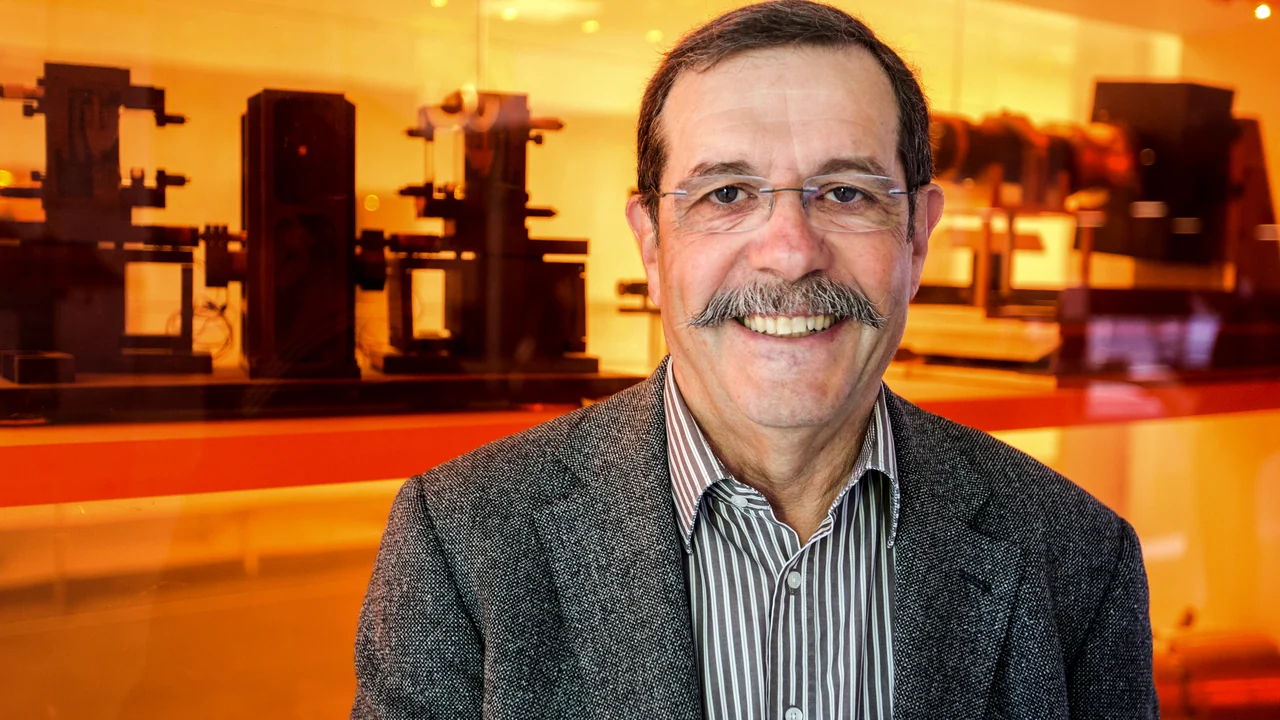
The 2022 Nobel Prize in Physics, announced on October 4, honored Alain Aspect, John F. Clauser and Anton Zeilinger. The experiments behind the award help explain why prearranged local instructions cannot, under the assumptions of a Bell test, account for correlations between entangled photons.
Comparing correlations across measurement settings
Two distant devices each measure the polarization of one photon in a pair. Researchers repeat the measurements while varying the devices' orientations. Suppose the photons carry shared instructions that are independent of the chosen settings, and each outcome depends only on its local setting and those instructions. The combined correlations must then stay within a bound set by a Bell inequality. Exceeding that bound rules out that combination of assumptions. Results recorded on one side alone cannot reveal the setting chosen on the other.
From the 1972 measurements to the 2015 tests
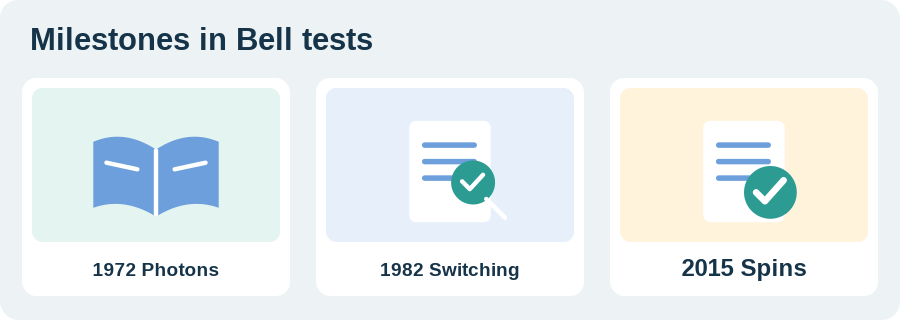
In 1972, Stuart Freedman and John F. Clauser published photon-polarization measurements whose correlations violated a Bell inequality. In 1982, Alain Aspect, Jean Dalibard and Gérard Roger published a test in which the analyzer orientations changed while the photons were traveling. In 2015, Bas Hensen and colleagues used electron spins separated by 1.3 km to address two major experimental loopholes in one test: possible communication between the devices and distortion of the sample when only detected pairs are counted. The 2022 prize recognized the three laureates' work with entangled photons and their pioneering role in quantum information science.
Primary sources
- École polytechnique · 4 oct. 2022
- The Royal Swedish Academy of Sciences · Nobel Prize in Physics 2022
- Freedman & Clauser · Physical Review Letters (1972)
- Aspect, Dalibard & Roger · Physical Review Letters (1982)
- Hensen et al. · arXiv:1508.05949 (2015)
- École polytechnique / J. Barande · Flickr
- JPEG · Wikimedia Commons
- CC BY-SA 2.0
- Nobel Committee for Physics · Scientific background (2022)
