Old photographs sharpen the orbit of dwarf planet candidate 2026 ED138
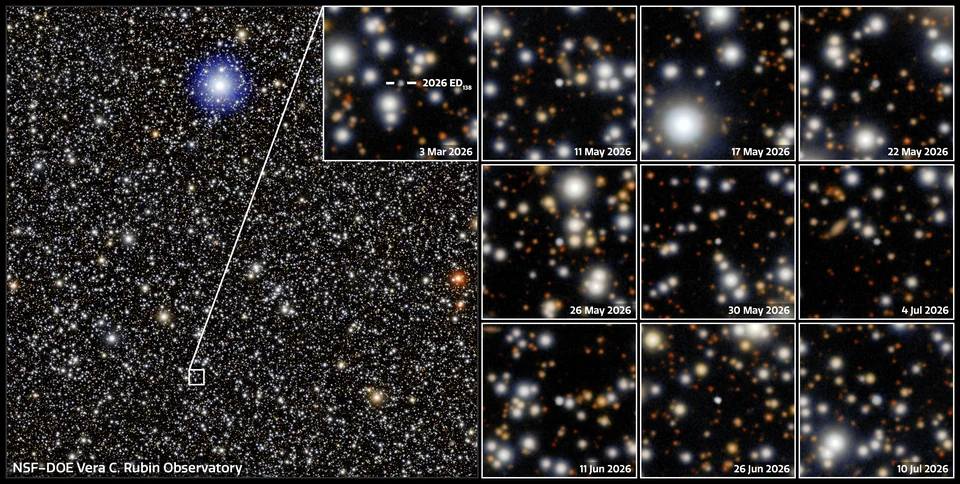
Astronomers traced 2026 ED138 back to photographic plates from 1954. The longer record narrows predictions of where the object will appear in the sky in the coming decades.

A discovery with a longer record
The Vera C. Rubin Observatory in Chile announced the discovery on October 27, 2026. In a November 2 preprint, Joseph Murtagh and colleagues report identifying the object on 12 photographic plates from 1954 to 2000. A possible detection on a 1937 plate remains uncertain. Adding the plates and older images from the VISTA and SkyMapper surveys reduced the uncertainty in predicted sky positions for 2035–2050 to about one fifth of the estimate based on Rubin and Dark Energy Camera data alone.
What a passing shadow could reveal
The authors predict 15 stellar occultations involving stars bright enough for many small telescopes between 2027 and 2030, under the study’s observing criteria. When the object passes in front of a star, observers at different sites can time how long the star disappears to estimate the object’s size and shape. The study presents observing predictions, and 2026 ED138 remains a dwarf planet candidate.