How one swap changes the five-card trick

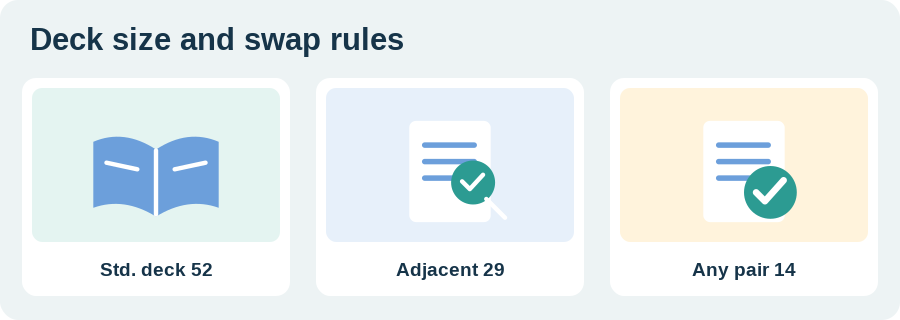
A November 2, 2026 preprint by Doron Levy and Yaakov Malinovsky shows that a standard 52-card deck cannot guarantee success in Fitch Cheney’s five-card trick if a spectator may make up to one swap of two neighboring face-up cards. The largest deck is 29 cards under that rule, or 14 if any pair of the four face-up cards may be swapped.
Four cards carry the message
A spectator picks any five distinct cards from the deck. An assistant chooses one to hide and lays out the other four face up. A partner who did not see the hand has to name the hidden card from those four cards and their order alone.
Why the swap rule matters
The spectator may leave the row unchanged or make one swap. If the same resulting row could come from two intended orders that signal different hidden cards, the partner cannot tell which card to name. The authors give a method attaining each limit for every five-card hand under its rule.

