Rubidium cloud reaches an equivalent 9.7 picokelvin aboard China’s space station

On November 6, the Chinese Academy of Sciences announced that researchers had lowered the equivalent temperature of a rubidium atom cloud to 9.7 picokelvin aboard China’s space station and observed the cloud for seven seconds.
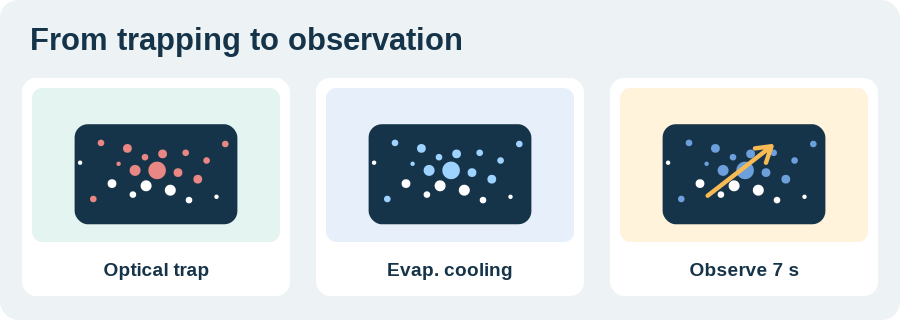
Cooling atoms with light
The ultracold atom facility launched with the Mengtian laboratory module in 2022. Researchers confined the rubidium cloud in an all-optical trap, reduced the light intensity for evaporative cooling, and then cooled the cloud further by nonadiabatic expansion.
A seven-second observation window
One picokelvin is 10⁻¹² kelvin. The equivalent temperature of 9.7 picokelvin describes how slowly the cloud expanded after release. Microgravity allows weaker confinement and a longer observation period after release. That longer window can support studies of ultracold atoms’ quantum behavior and precision measurements using techniques such as atom interferometry.
