South Korea's adult obesity indicator reaches 35.4%; over half of men in their 30s and 40s affected
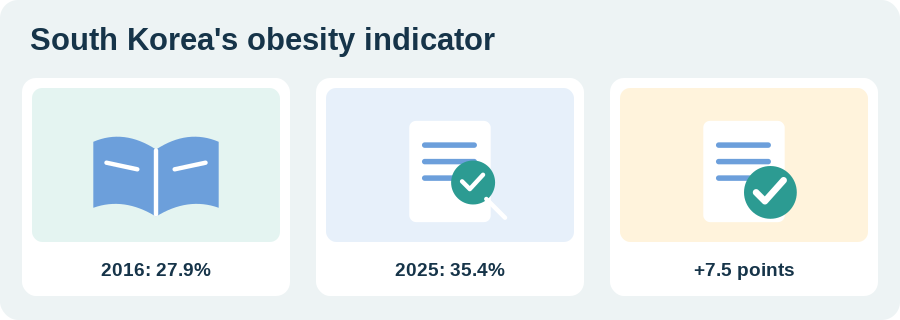
A new KDCA analysis of the 2025 Community Health Survey puts the national indicator at 35.4%, up 7.5 percentage points from 2016.
National indicator is a median of local rates
The Korea Disease Control and Prevention Agency's in-depth analysis, posted on November 9, uses data from the 2025 Community Health Survey of 231,615 adults aged 19 or older. It classifies people as having obesity when their body mass index, calculated from self-reported height and weight, is at least 25 kg/m². The national indicator is the median of population-standardized rates for 258 cities, counties and districts. At 35.4%, it is 7.5 percentage points above the 2016 figure of 27.9%, a relative increase of 26.9%.
Rates exceed 50% among men in their 30s and 40s
The analysis reports an obesity rate of 42.5% for men and 22.9% for women. Among men, the rates were 52.1% in their 30s and 53.1% in their 40s. Among women, the highest age-group rate was 27.4% for those aged 70 or older.
Ulsan highest, Sejong lowest among provinces and major cities
The 2025 rates by province and major city ranged from 38.2% in Ulsan to 29.4% in Sejong. Rates rose in every province and major city except Sejong compared with 2016. KDCA called for local prevention measures tailored to residents' health behaviors and regional conditions.
Primary sources
- KDCA · In-depth analysis of obesity in the 2025 Community Health Survey
- KDCA · Release of 2025 survey statistics and raw data
- Community Health Survey · Definition of the obesity indicator
- KDCA · In-depth analysis of obesity in the 2025 Community Health Survey (PDF)
- Bathroom Scale.jpg · Angelsharum · Wikimedia Commons
- CC BY-SA 3.0
