TESS stopped seeing TOI-2535 b cross its star
Between April 2019 and March 2026, NASA’s TESS space telescope watched the star TOI-2535 in five observing windows. A giant planet’s crossings grew shorter and shallower, and the telescope detected none in March 2026. A UCLA-led team found evidence that another planet’s gravity could explain the change.
A path that shifted toward the star’s edge
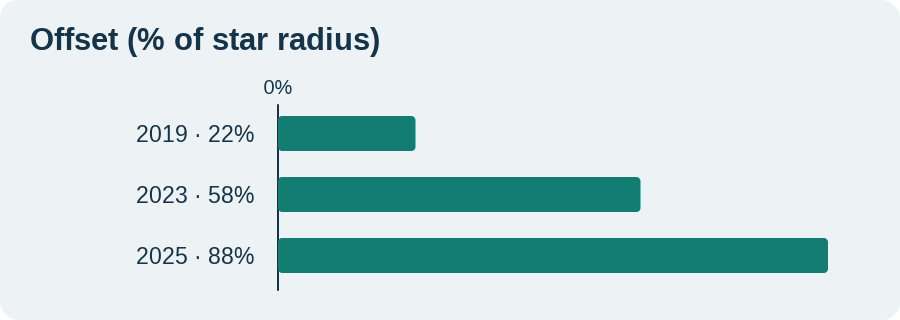
A transit occurs when a planet passes in front of its star as seen from Earth, blocking a small fraction of its light. TOI-2535 b orbits roughly every 8.2 days, but the observed crossings ran up to six hours early or late compared with a fixed schedule. Over successive observations, the planet’s apparent path shifted toward the edge of the star’s disk. By March 2026, the researchers found no transit signal even when they searched across a wider time window.
Two clues point to an unseen neighbor
The team modeled the timing and duration of the transits alongside NEID spectrograph measurements of the star’s motion toward and away from Earth. The combined data suggest a nearby planet whose orbital plane is tilted by at least about five degrees relative to that of TOI-2535 b. Gravitational interaction can gradually turn the orbital planes, shifting where the known planet passes relative to the star in our view. The companion is inferred from the data, and its exact orbit and the timing of any future visible transits remain uncertain.