35.2% of Japan’s municipalities formally adopted telework, with a wide gap by staff size
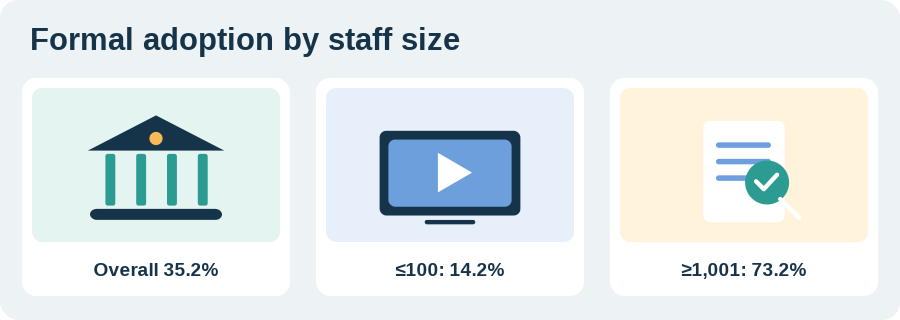
A tally of survey tables published on November 9 by Japan’s Ministry of Internal Affairs and Communications shows that 605 of 1,721 municipalities had formally adopted telework as of July 1, 2026. The share was 14.2% among municipalities with 100 or fewer general administrative staff and 73.2% among those with at least 1,001.
Ministry survey of local government telework, July 1, 2026 (e-Stat, in Japanese)
605 municipalities had formal arrangements and 450 were running trials
The ministry’s tables separate prefectures, designated cities and other municipalities. In the municipal table, 605 had formally adopted telework and 450 had introduced it on a trial basis. Another 46 were considering adoption, while 620 had no plans or had yet to decide. Formal adoption stood at 44 of 47 prefectures and all 20 designated cities.
65 of 459 municipalities with 100 or fewer staff had formally adopted it
The staff counts cover general administrative staff as of April 1, 2026. Among municipalities with 100 or fewer such staff, 65 of 459 had formally adopted telework. Among those with 1,001 or more, 93 of 127 had done so. The rates count municipalities. The tally does not show how many employees worked remotely or how often they did so.
Formal adoption rose by 36, while the total including trials fell by eight
The previous survey, as of October 1, 2025, recorded 569 formal adopters and 494 trial adopters among 1,721 municipalities. Together, they accounted for 1,063 municipalities in the previous survey and 1,055 in the latest one. Changes between the two snapshots include moves from trials to formal adoption, so the rise in formal adoption alone does not show how many municipalities began offering telework.
