Chandra detects X-rays during an outburst of AT 2016blu
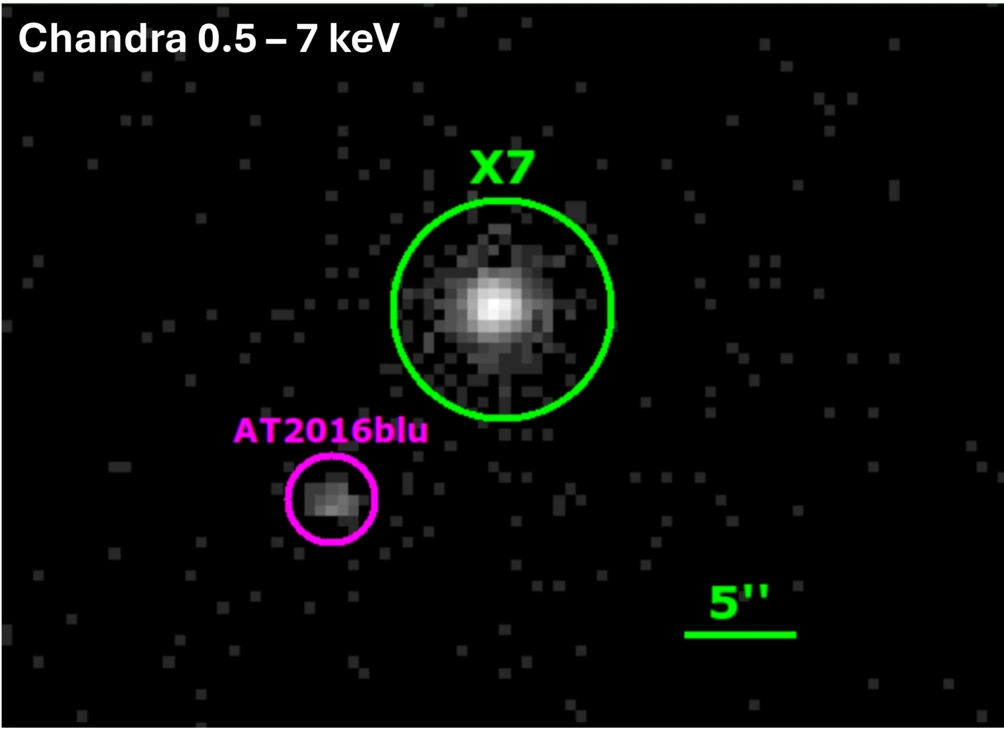
Chandra detected X-rays from AT 2016blu in five observations during a March 2026 outburst. The team’s November 9 announcement links the repeated brightening to gas falling onto a possible neutron star or stellar-mass black hole.
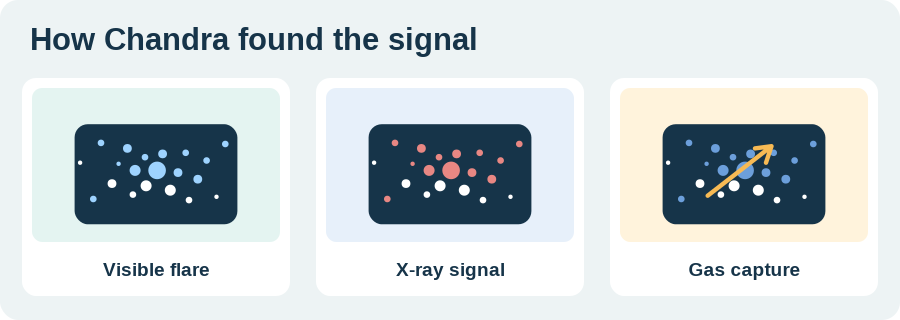
Visible light helped time the observations
AT 2016blu, a massive star in the galaxy NGC 4559, brightens in visible light roughly every 113 days. That pattern helped astronomers schedule Chandra observations during an outburst. The X-ray luminosity measured in March was about 100 times the upper limit inferred from 2001–2002 observations, when no source was detected at the star’s position.
Two possible companions
The team’s interpretation is that a companion captures gas from the star when the two objects are closest in an elongated orbit. As the gas falls toward the companion, it heats up and emits X-rays. The observations leave open whether the companion is a neutron star or a stellar-mass black hole.