NASA studies how LISA could find planets around white-dwarf pairs

Two studies model how the future gravitational-wave observatory could find planets and how the James Webb Space Telescope could check nearby candidates.
A planet’s effect on the signal
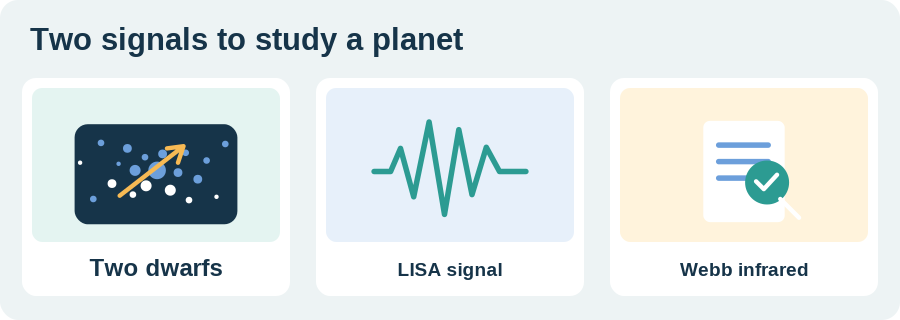
Two studies published on 10 November describe how a planet orbiting two white dwarfs could pull on the pair and shift the frequency of the gravitational waves that LISA would measure. The planet’s pull would produce extra signals above and below the main frequency.
How Webb could check a candidate
The researchers modelled the known white-dwarf pair ZTF J2243+5242 at an assumed distance of about 500 light-years. In that example, Webb could pick up excess infrared light from a planet about five times Jupiter’s mass. Under ideal conditions, LISA could detect a planet less massive than Jupiter. The figures describe a model. ESA leads LISA with NASA participation and plans a launch in the mid-2030s.