A white dwarf and a Sun-like star traced to radio pulses every 7.9 minutes

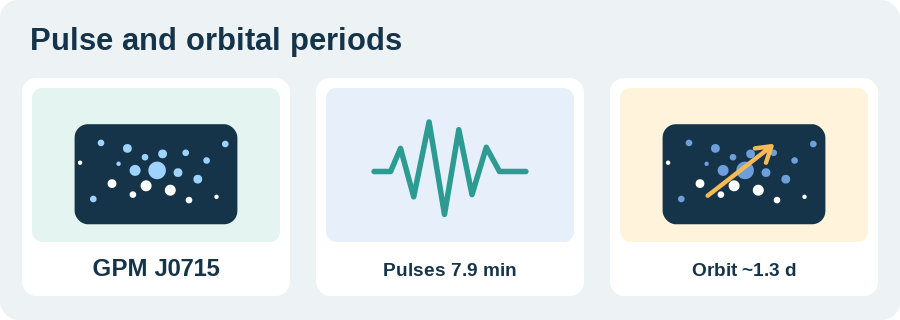
Astronomers linked the repeating radio source GPM J071507−114153 to a binary containing a low-mass white dwarf and a Sun-like G-type star. The pulses recur every 7.9 minutes. A second period of about 1.3 days is interpreted as the time the stars take to orbit one another.
How the team located the source
The researchers detected the source with the Murchison Widefield Array in Australia and refined its position with MeerKAT in South Africa. Optical spectroscopy from the Keck Observatory in Hawaiʻi identified the G-type companion. The arrival times of the radio pulses varied over the inferred orbit, placing their source close to the white dwarf.
What the two periods tell us
The 7.9-minute interval describes the repeating radio signal. The roughly 1.3-day modulation is consistent with the orbit of the pair. Changes in the polarisation of the pulses are consistent with the radio waves passing through magnetised material in the companion’s corona. The observations constrain where the pulses come from. The precise emission mechanism remains open. See the research team’s illustration.