Taiwan used-car dispute study compares how often AI cites relevant provisions across 242 judgments

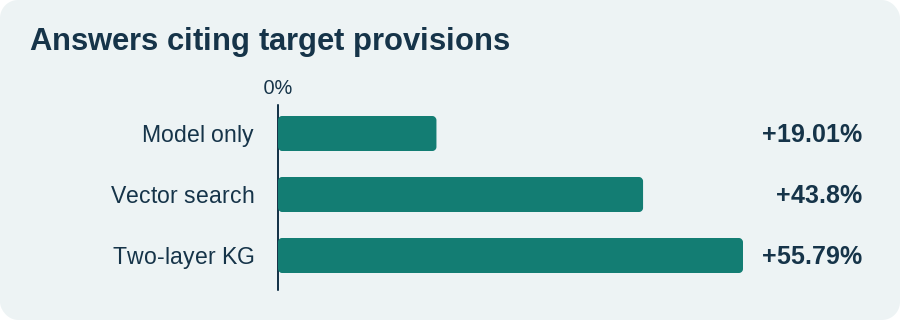
In the November proceedings of ROCLING 2026, Bo-Zhi Yao and Yi-Ting Peng reported a method that uses a knowledge graph linking laws and past judgments to support retrieval for generative AI in Taiwan used-car disputes. In an evaluation using 242 judgments, 55.79% of answers from the proposed method cited at least one reference provision, compared with 19.01% for the same language model alone.
Two layers connect laws with past judgments
The study combined a layer organizing Taiwanese laws with a second layer containing 444 civil judgments from 2000 to 2020. It used 242 judgments from 2021 to 2025 exclusively for evaluation. The top eight search results contained at least one reference provision in 62.81% of cases. In a supplemental evaluation that also counted predefined related provisions as matches, the rate was 63.22%. The authors identified related provisions based on how often they appeared together in judgments and said validation by multiple experts remains future work.
Provision citations and claim risk measured separately
In the comparison using Qwen2.5-14B, at least one reference provision appeared in 19.01% of answers from the model alone, 43.80% of answers with conventional vector search, and 55.79% with the proposed method. The share of answers recommending at least one claim that the study defined as having a success rate below 30% in past judgments was 11.16%, 0.00%, and 0.41%, respectively. The researchers used a language model to create the evaluation questions and compile the reference provisions. They checked the extracted provisions against the judgment texts.