ConvoDrift uses 15,727 synthetic conversations to study shifts in writing style
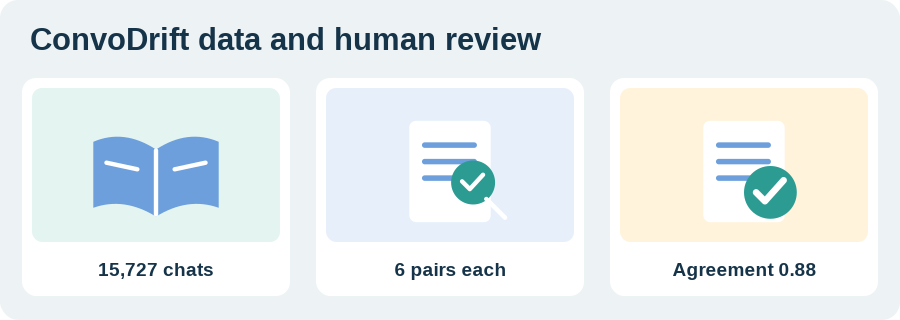
Vihindi Kotalawala and colleagues introduced ConvoDrift in the ROCLING 2026 proceedings. The dataset is designed to study how writing style shifts during a conversation while the intended meaning stays the same. Its 15,727 synthetic conversations each contain six instruction-and-response pairs.
Tracking shifts between formal and casual language
The researchers created a range of settings, including work and everyday situations, and marked whether the style of each response shifted and in which direction. They also paired responses with the same meaning and different styles to test which one would be picked under five predefined speaking preferences.
Three reviewers rated the same 175 conversations
The human review covered 850 distinct conversations. All three reviewers rated a shared subset of 175. The mean Krippendorff’s alpha across seven criteria was 0.88 on that subset. The authors noted that synthetic dialogue can capture only part of the variety and natural progression of real conversations.