BM25-guided generative retrieval falls short of the baseline in a benchmark
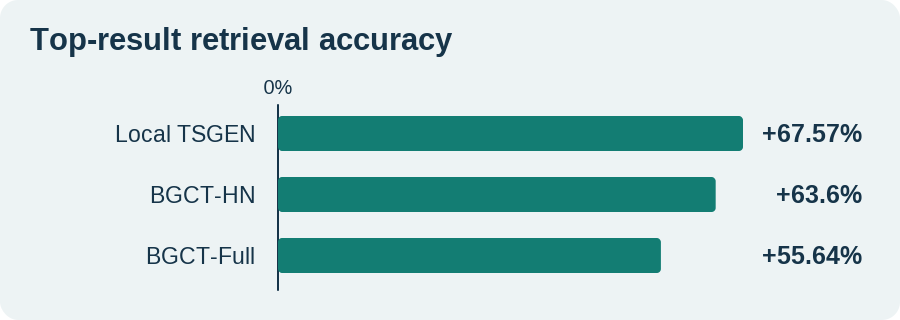
Ping-Hsun Wu and Jheng-Long Wu reported BGCT, a method that uses the keyword search algorithm BM25 to train a generative document retriever, in the November proceedings of ROCLING 2026. On the NQ320K dataset, the combined method put the correct document first 55.64% of the time, compared with 67.57% for the baseline the authors reproduced.
The two retrievers return different candidates, but training lowers performance
Generative retrieval finds documents by having a model output their identifiers. The authors found little overlap between the top 100 candidates returned by generative retrieval and BM25. If it were always possible to select the correct top result whenever either system found it, the authors estimated a theoretical maximum of 78.16%. In the experiments, training only on plausible incorrect candidates ranked highly by BM25 achieved 63.60%. Using only knowledge distillation from BM25’s search results achieved 59.28%.
The reproduced baseline differs from the original paper’s result
The 67.57% comparison point came from the authors’ reproduction of TSGEN. The paper that introduced TSGEN reported 70.82%. In the new experiments, assigning more weight to knowledge distillation from BM25 lowered the top-result success rate. Although the two systems returned complementary candidates, the training did not improve results. The main comparison used the same T5-Base model and was limited to 7,830 validation queries in the English-language NQ320K dataset.