For Chinese texts by new immigrants, models estimated emotional valence more closely than arousal

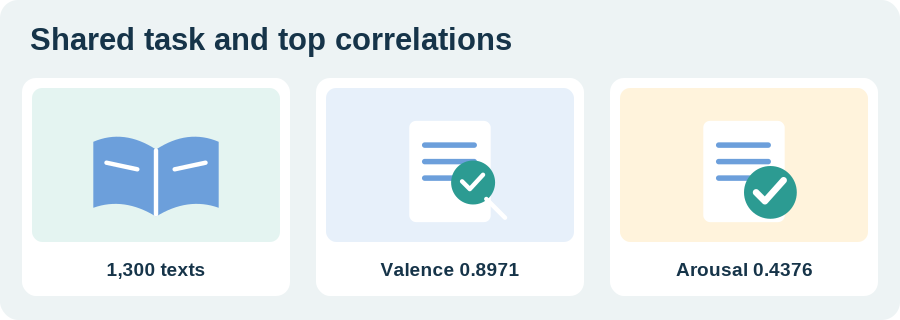
Tzu-Mi Lin and colleagues reported the results of a shared task on estimating emotional valence and arousal from Chinese texts written by new immigrants. The November ROCLING 2026 proceedings documented eight participating teams, seven of which entered the final ranking. The winning CYUT team’s predictions correlated with human ratings at 0.8971 for valence and 0.4376 for arousal.
Training and evaluation used different sources
The official training data came from part of Chinese EmoBank, an existing Chinese-language emotion dataset. New immigrants wrote the 200 development and 1,100 test texts in Chinese about their experiences and feelings. The organizers used human scores for each text as a reference. Mean absolute error measured the size of the difference between predictions and reference scores. Pearson correlation measured how closely they varied together.
CYUT led all four ranked measures, with lower arousal correlations across teams
The organizers averaged the ranks across two measures each for valence, which describes how positive or negative an emotion is, and arousal, which describes how activated it is. CYUT ranked first on all four measures. Its mean absolute errors were 0.5366 for valence and 0.8658 for arousal. Each of the seven ranked teams had a lower correlation for arousal than for valence. The organizers identified estimating arousal from texts by writers with varied linguistic backgrounds as a remaining challenge.