Using words and sentence structure reached 90.20% accuracy in a six-way question classification test
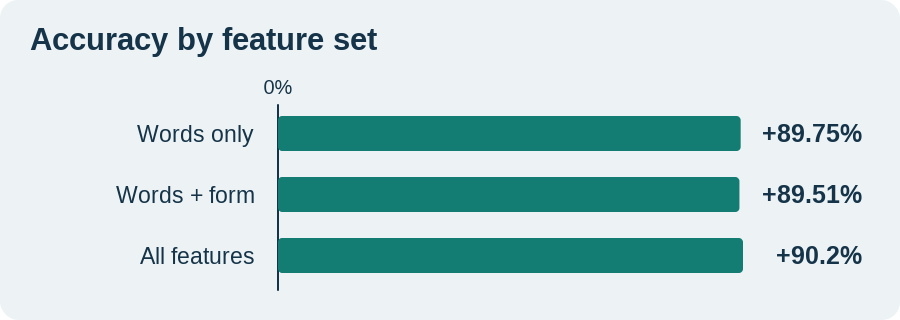
Kuei-Mei Lin and Jui-Feng Yeh of National Chiayi University in Taiwan reported a method that uses words and sentence structure to identify the type of answer a question asks for. The paper appeared in November in the ROCLING 2026 proceedings. On a TREC classification task, the method reached 90.20% accuracy with several features combined, compared with 89.75% using words alone.
The method uses parts of speech and character forms as well as question words
A question may lack a question word, or the question word alone may leave the intended answer type unclear. The researchers used words, sentence structure, parts of speech, question words and features such as capital letters and digits. The TREC data used in the paper divide questions into six categories, covering abbreviations, descriptions, entities, people, locations and numbers. The authors report splits of 5,500 questions for training, 550 for validation and 550 for testing.
Adding character-form features alone lowered accuracy
Adding character-form features to words resulted in 89.51% accuracy, lower than using only words. A linear support vector machine using all the features, including parts of speech and question words, reached 90.20%. These figures measure classification of the question type before any answer is generated.