A model with about 900,000 parameters separates two voices from a noisy recording

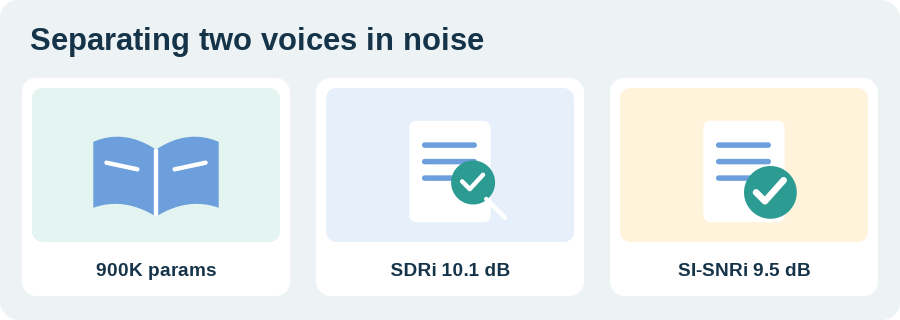
Shao-Chun Hu and colleagues in Taiwan presented GTCRN-SS, a model for separating two voices mixed with noise in single-channel audio, in the ROCLING 2026 proceedings in November. On noisy Libri2Mix data, it improved the signal-to-distortion ratio by 10.1 decibels and the scale-invariant signal-to-noise ratio by 9.5 decibels relative to the original mixture.
The model separates other sounds and refines its estimate of each voice
The model first estimates the speakers’ voices from the mixture and routes other sounds through a separate internal path. It then uses its initial voice estimates to refine the separation. The model does not use features from later processing frames, although calculating the input features does use up to 16 milliseconds of future audio.
The team tested performance and computation on 3,000 clips
The model tested on 3,000 clips sampled at 8 kilohertz had about 900,000 trainable parameters. Processing one second of audio took about 6.1 billion multiply–accumulate operations. In a comparison table of previously reported results, the more computationally expensive TF-GridNet-Causal scored higher on both separation metrics. The researchers evaluated the model by processing entire recordings offline. They identified latency and memory use during streaming as questions for future tests.