Study uses AI to recover mixed Chinese and English text typed in the wrong input mode
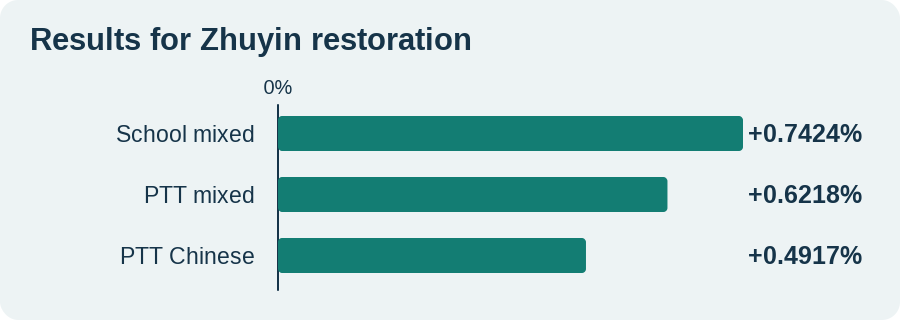
Hsin-Jui Li and colleagues reported a method for recovering what a user meant to type after forgetting to switch to the Chinese phonetic input method Zhuyin. The study appeared in November in the ROCLING 2026 proceedings. The method uses a table mapping keys to phonetic symbols to restore the Chinese while keeping English words. On 159 mixed Chinese and English sentences collected at a school, it reached a best ROUGE-L score of 0.7424, which measures similarity to the intended text.
Key mappings and context serve different purposes
Without knowing how keys map to Zhuyin symbols, it can be difficult to recover the intended sentence from a string of Latin characters. The team gave the model the mapping and conversion steps and used context to decide which English words to keep and which parts to convert. The study used gpt-oss-120b. The Zhuyin tests included 159 sentences collected at a school, 600 sentences containing English from the Taiwanese forum PTT, and 600 Chinese-only sentences from the same forum. At the high reasoning setting, the method scored 0.7424, 0.6218 and 0.4917 respectively on ROUGE-L.
The study also tested other input methods using simulated mistakes
The team changed the mappings and conversion steps for Cangjie, which encodes Chinese characters by their components, and for Korean and Japanese input methods. The test strings were generated from the original sentences. Real users may make different errors, such as missing or adding keystrokes. The researchers tested one model and noted that automated ROUGE-L scores capture only part of whether the restored text is semantically correct.