Narrowing the word list reduced errors in Chinese speech recognition
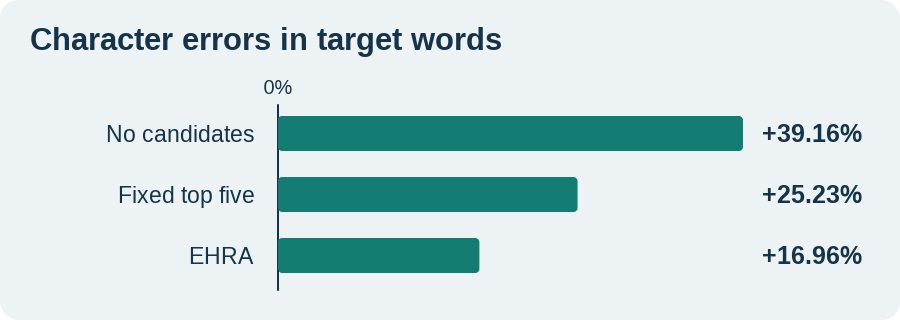
Chiun-Yu Hua and colleagues reported EHRA, a method for narrowing the list of words that might be hard to recognize, including personal names, for each utterance. In experiments on the AISHELL-1 Chinese speech dataset, the character error rate for the target words fell from 25.23% with a fixed top-five rule to 16.96% with EHRA. The study appeared in the ROCLING 2026 proceedings.
Selecting candidates by meaning and pronunciation
The researchers combined a method that represents text as numbers to measure similarity in meaning with a method that compares pronunciation using Hanyu Pinyin. They used multiple criteria to narrow the candidate list. The aim was to reduce cases where irrelevant candidates cause the recognizer to insert words that the speaker never said.
Measuring errors in target words and in full transcripts
The team evaluated Qwen3-ASR-0.6B on 7,176 AISHELL-1 utterances with a list of 400 terms and kept the model’s pretrained weights unchanged. The character error rate for the target words was 39.16% without candidates, 25.23% under the fixed top-five rule and 16.96% with EHRA. For full transcripts, the rates were 2.09%, 2.28% and 1.88%, respectively. The team also observed improvements over the baseline when it switched the text embedding model used to retrieve the candidates.