Speech recognition study breaks errors into three types in simulated medical visits
Ming-Kun Chou and colleagues presented DRPF, a method for investigating speech recognition errors by type, in the ROCLING 2026 proceedings. In a comparison that simulated a medical visit, two approaches with similar character error rates on ordinary sentences made different kinds of errors on short replies.
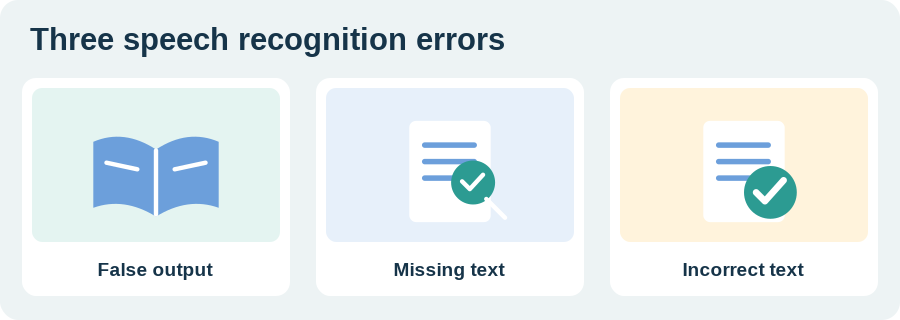
Text without speech counts as a separate error
The method distinguishes output when there is no speech, empty output when speech is present, and incorrect transcription of speech. The authors designed it to help choose a response for each error type, such as filtering unwanted output, listening again or sending a transcript for human review.
Cloud and on-device processing fail in different ways on short replies
For sentences prepared by doctors to simulate general medical visits, the character error rate was 11.2% in the main cloud configuration and 7.6% on the device. In 400 recordings that included short replies, the cloud system produced incorrect transcriptions in 243 cases. The on-device system returned empty output in 72 cases and produced incorrect transcriptions in 60.
The study also compared different language settings
When the language setting was the only difference in the cloud configuration, the researchers saw changes in examples where short negative replies were replaced with medical terms and in the proportion of Taiwanese words the system recognized. The authors used recordings of four people reading a script. The study did not measure performance across real clinical practice.