Sinhala legal document summaries were tested for consistency with their sources
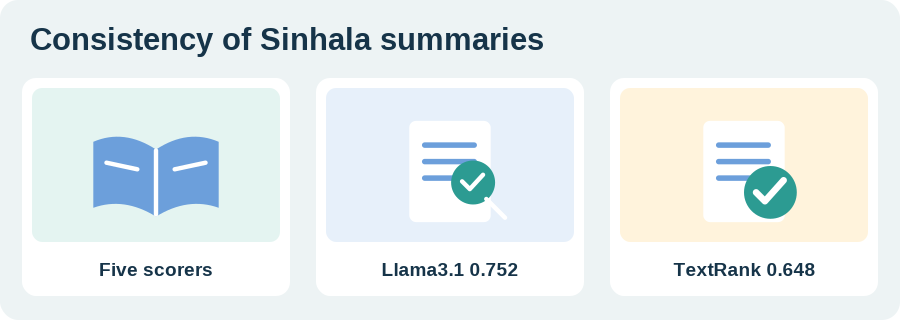
Minduli Lasandi and Nevidu Jayatilleke introduced SinBrief, a method for summarizing Sinhala legal documents, in the November ROCLING 2026 proceedings. It constructs new sentences by recombining words from the source text, without training data paired with human-written summaries. In the automated evaluation, the version that used Llama 3.1 to select sentences had the highest score for consistency with the source among the methods compared.
Linking words that occur together and scoring candidate sentences
The researchers split 1,206 acts and bills into 964 training documents and 242 test documents. They grouped sentences by similarity in meaning and built a graph linking words that appeared together. They generated candidate summary sentences from these links and scored them using five configurations, including language models. SinBrief shared fewer consecutive words with the source than the comparison methods that extracted sentences verbatim.
The authors found grammar errors and left systematic human evaluation for future work
The Llama 3.1 configuration scored 0.752 on SummaC, an automated measure of how consistent a summary is with its source. TextRank, the best baseline on this measure, scored 0.648. The authors treated the scores as a guide for comparison because the automated metric has limitations for long Sinhala legal sentences. They identified grammatical errors in generated summaries and left systematic evaluation by native speakers for future work.