Taiwanese history search prototype recovered nine of 15 group affiliations stated in records
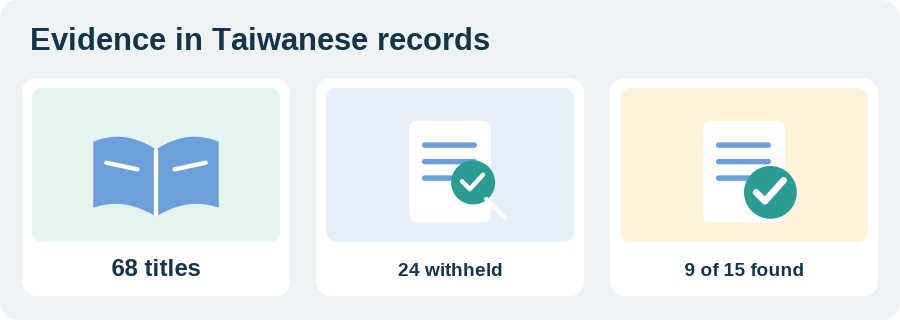
Chun-Shih Cheng and colleagues tested a search system for Taiwanese historical records and reported their findings in the November proceedings of ROCLING 2026. In public records relating to contracts from 1804 to 1818, inferring affiliations from a shared document or surname assigned group labels the records did not state. The prototype answered only when it had explicit source support. It assigned no unsupported labels and recovered nine of the 15 stated affiliations.
Catalogue titles left 24 event questions unanswered
The team distinguished events such as contracts from claims about which group a person belonged to at a particular time. The system answered only when it could cite a source. Using 68 public catalogue titles, it answered 44 event questions and withheld answers on 24. In 18 of those cases, the title did not name the other party. The catalogue also had 11 titles with uncertain text and five pairs of identical titles.
Shared documents and surnames led to unsupported labels
The researchers wrote 27 questions about group membership using seven public records, including reproduced contract passages and catalogue metadata. A rule based on appearing in the same document assigned 12 unsupported labels. A rule based on a shared surname assigned five. The six stated affiliations the prototype missed appeared in passages where one group label applied to several names. Following links between sources improved the top three results on one question about an alternative name and made them worse on one question about a map. The paper presents the results as an audit based on a small set of cases.