An AI tool reviews book summaries one issue at a time, with one teacher rating 157 rounds

Meng-Che Chan and colleagues developed an AI system that flags one issue at a time to help learners revise their own book summaries. In a paper published in November in the ROCLING 2026 proceedings, they reported that one practising Chinese language teacher rated 157 rounds of feedback. Average scores for each of eight criteria ranged from 2.91 to 3.00 out of 3. The evaluation did not measure learning outcomes.
The system starts with comprehension and moves to writing
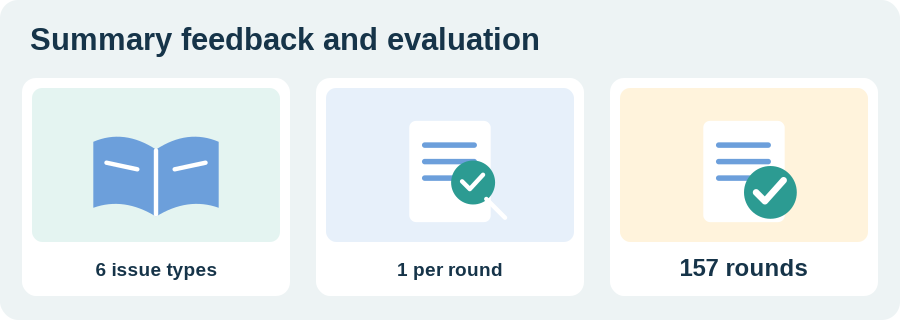
The system uses the Gemma 4 31B large language model. It identifies six kinds of issues in a summary: misunderstandings, problems with logic, omissions, subjective statements, unnecessary details and poor cohesion. It gives priority to comprehension before expression and addresses the highest-priority issue in each round. It uses hints, questions and multiple-choice prompts to guide revisions while leaving the final wording to the learner.
The teacher evaluated 36 simulated tasks
The teacher played the learner and revised summaries in response to feedback across 36 simulated tasks. Each task could involve multiple rounds, so the paper did not count the 157 rounds as independent experiments. The teacher gave full marks for withholding complete answers and for qualities including consistency and natural wording. The system sometimes missed the main issue or asked for revisions to a nearly finished summary. The authors note that only one person rated the feedback. They did not test whether real learners improved their summaries or reading comprehension.