News timeline method processes 731 articles in about 30 minutes on a laptop
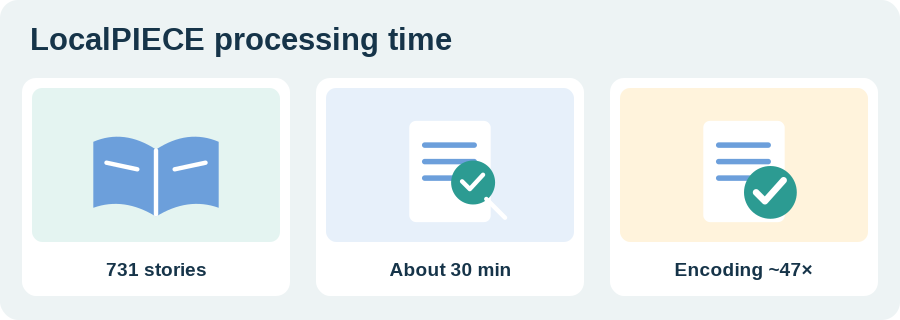
Chien-Yu Chu and Yi-Shin Chen of Taiwan’s National Tsing Hua University presented LocalPIECE in the ROCLING 2026 proceedings, published in November. The method selects event dates from news articles to build a timeline. A test on 731 stories about one topic in Taiwan took about 30 minutes end to end on a consumer laptop. Peak main memory and GPU memory use were 2.2 GB and 2.5 GB, respectively.
The method distinguishes event dates from publication dates
LocalPIECE connects reporting across articles while accounting for different names for the same person and for gaps between an event and publication. The researchers ran one comparison with preprocessed data from an existing method and a separate test that included preprocessing on the laptop. In the first comparison, processing search terms took 1.64 seconds instead of 77.04 seconds, with the same date-ranking score.
The better way to select dates depended on the topic
On two topics, the researchers compared methods that identify periods of sustained change in coverage and points when coverage shifts. Which method scored higher depended on the topic. The authors identified setting thresholds without reference dates and automatically narrowing down the dates on the final timeline as future work.