Study tests two open models for processing electronic health record queries locally

Grace Chan and Po-Chih Kuo reported a system that converts questions written in ordinary language into SQL for querying electronic health records. Introduced in the November ROCLING 2026 proceedings, the system combines two openly available language models and is designed to avoid sending information to external servers. On the EHRSQL 2024 shared task it scored 44.99 on RS(10), which penalizes wrong answers, ahead of the other open-model approaches included in the paper’s comparison.
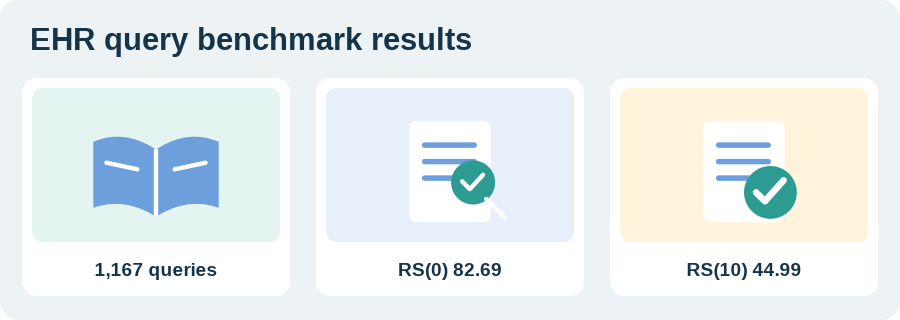
Score of 44.99 under a metric that penalizes wrong answers
The researchers assessed the confidence of the generated results and combined the two models’ outputs using rules. The shared task test had 1,167 questions, about 20% of which could not be answered with the information provided. The system scored 82.69 on RS(0), which imposes no penalty for wrong answers, and 44.99 on RS(10), which does. A leading approach using proprietary models scored 88.17 and 81.32, respectively. Under RS(N), which penalizes mistakes more heavily, the system trailed some of the open-model approaches in the comparison.
The evaluation was limited to benchmark queries
The authors proposed a locally deployable system to keep sensitive information from being sent to services outside the hospital. The reported scores measure whether it returned the results asked for in the shared task. The study did not report results from clinical deployment or measure how well personal information would be protected in operation.