Reviewing AI replies from four perspectives raised emotional support scores

Kuan-Lin Yu and colleagues introduced EmoReflect, a method that reviews and revises AI-generated replies to people seeking emotional support from four perspectives. In experiments on a dataset of support conversations, all three language models scored higher overall after review than when they generated replies directly. The study, published in the November ROCLING 2026 proceedings, assessed the quality of the generated replies. It did not measure therapeutic outcomes for people seeking support.
Estimating emotions and reviewing the draft reply
EmoReflect estimates how pleasant or unpleasant and how emotionally stirred up the speaker seems from what a person says, then drafts a reply. Four specialized AI agents review the draft for cognitive reflection, emotion regulation, the help-seeker’s needs and realistic guidance. The system uses relevant feedback to revise the reply. The evaluation rated six criteria on five-point scales, including emotional understanding, the helpfulness of suggestions and how easy they were to put into practice.
Three graduate students scored 50 examples, with gains varying by model
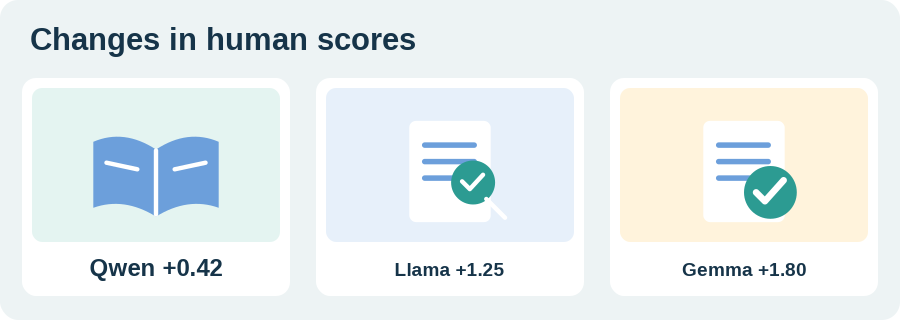
The researchers tested Qwen2.5-7B, Llama-3.1-8B and Gemma-2-9B on the ESConv dataset of support conversations. Three graduate students scored 50 randomly selected examples. Total scores out of 30 rose from 24.40 to 24.82, from 22.75 to 24.00 and from 19.77 to 21.57, respectively. All three models also scored higher overall in an automated GPT evaluation. Human scores for fluency and naturalness edged down for Qwen2.5-7B. None of the human evaluators had formal training in psychology or counseling.