SCUNLP places second in Chinese sentiment analysis using AI-generated notes

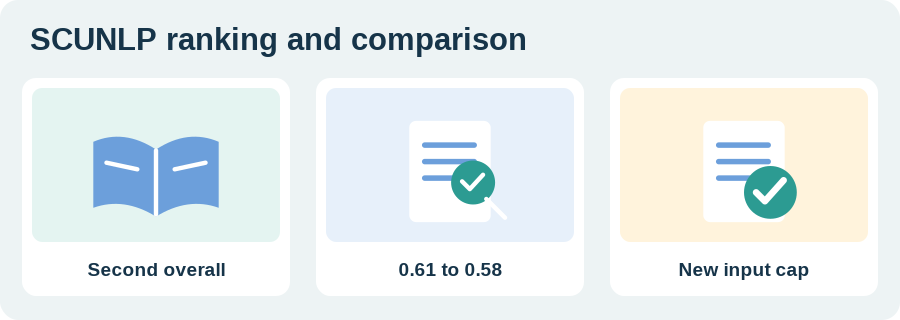
Hsiang-Wei Chen and colleagues on team SCUNLP placed second among seven ranked teams in a ROCLING 2026 shared task on sentiment in Chinese texts by recent immigrants. The November proceedings report that mean absolute error for valence was 0.58 with AI-generated descriptions of emotions, compared with 0.61 in the comparison condition. The model’s input limit also increased in that comparison.
The team added AI-generated notes to the original text
SCUNLP used gpt-5.4-mini to generate text about the emotions in each sample and appended it to the original. The team fine-tuned a Chinese BERT model to predict valence, the pleasantness or unpleasantness of an emotion, and arousal, its level of activation. Training used Chinese EmoBank and labeled data from the previous year’s shared task, for a total of 7,094 examples after cleaning. The organizers reported a mean absolute error of 0.5793 and a Pearson correlation of 0.8815 for valence, and 0.8951 and 0.4050 for arousal.
The augmented model could also read a longer input
The comparison capped BERT’s input at 128 tokens without the extra text and 256 tokens with it. The authors said the reduction in error from 0.61 to 0.58 cannot be attributed separately to the added text or the longer input limit. They trained each configuration once and did not verify small differences with repeated runs or confidence intervals.