Paiwan translation study produces translations for three of 46 dialogue sentences
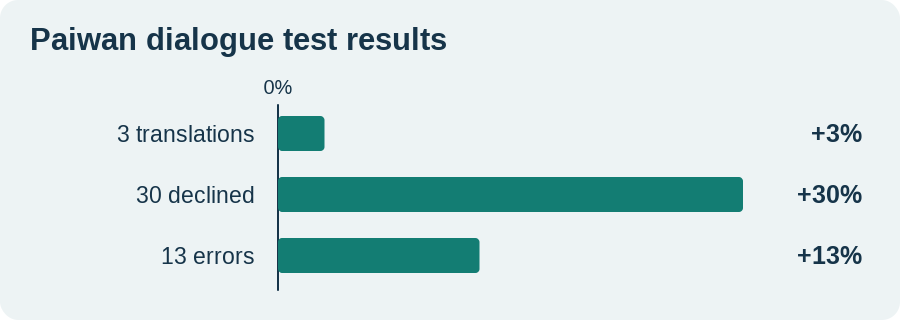
Yung-Yu Huang reported a machine translation study in the ROCLING 2026 proceedings that used a Paiwan–Chinese bilingual corpus to generate candidates and reverse translation to check their consistency. Of 46 dialogue sentences, the system produced one correct and two partial translations, for a coverage rate of 6.5%.
Searching 5,923 bilingual entries for translation candidates
The research focused on Eastern Paiwan, a variety with limited digital resources. The system searched 5,923 Paiwan–Chinese entries for relevant examples and generated candidate translations. For 29 of the 40 words or short phrases used in the evaluation, both the input and its reference translation appeared together in the corpus. Across all 40 items, 23 translations exactly matched the reference after normalising the text, or 57.5%. Under a looser criterion, 30 matched, or 75.0%.
A separate consistency check, with refusals and errors in dialogue
Of the 46 dialogue sentences, the system declined to translate 30 and encountered processing errors on 13. In the separate reverse-translation evaluation on the 40 words and phrases, 23 of the 25 candidates judged consistent also matched the references under the study’s automated rules. That gave a precision of 92.0%. The author describes this as a measure of candidate consistency. Verifying translation correctness would require independent evidence.