AI revises utility model claims in stages in a study of 150 Taiwanese cases

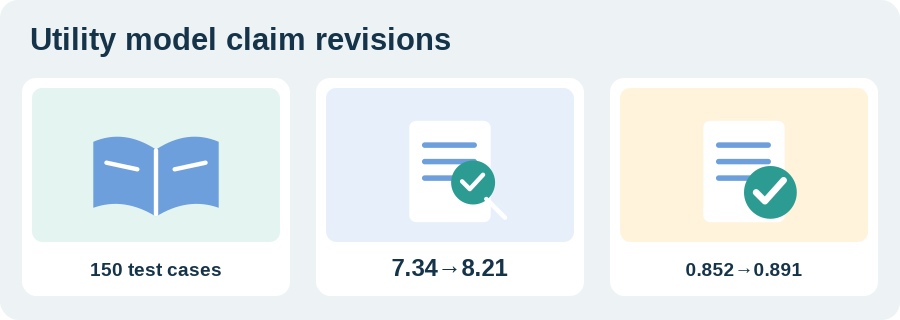
Chia-Te Huang presented PLM in the November proceedings of ROCLING 2026. The method uses generative AI to revise utility model claims through multiple rounds, scoring features such as relationships between components and consistency of terminology. In a test on 150 Taiwanese utility models, the combined score across four criteria rose from 7.34 for direct revision by GPT-4o to 8.21 for staged revision.
The method checks component relationships when choosing revisions
The method uses GPT-4o to generate multiple candidate revisions. It scores intermediate drafts on completeness, clarity, consistency of terminology, and relationships between components. It extracts those relationships from the original specification and claims and also checks whether the revisions retain the technical features stated there. In a comparison with matched computing budgets, Huang reported that most of the improvement came from revising the claims in stages.
Automated scores improved. Practitioner assessment remains future work
On the 150 held-out test cases, the combined score across four criteria rose about 11.9%. The largest gains were in consistency of terminology and relationships between components. The supplementary BERTScore rose from 0.852 to 0.891. The paper reports that the method could not detect when a revision added conditions that narrowed the scope of protection. The study did not test for statistical significance and listed assessment by practitioners as future work.