AI and teacher scores for high school summaries correlated at 0.83 in literature and 0.89 in science
Ru-Yi Huang and colleagues compared how an AI system and a teacher scored summaries of Chinese-language texts by first-year high school students. In the study, published in the November ROCLING 2026 proceedings, the Pearson correlation between total scores was 0.83 for the literary text and 0.89 for the popular science text.
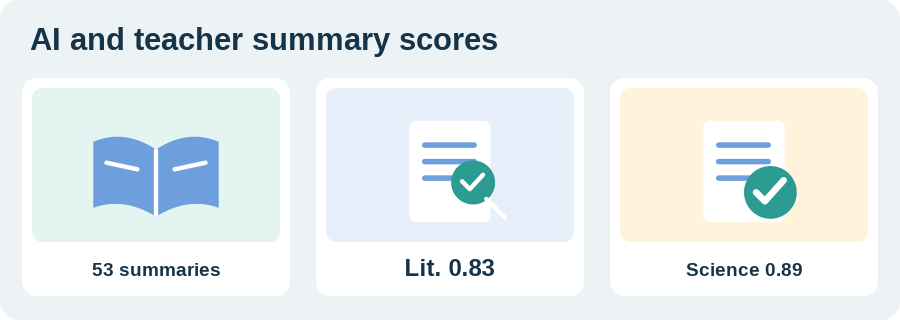
Comparing 53 summaries from two high school classes in Taipei
Two classes taught by the same Chinese-language teacher participated at a Taipei high school. One class of 29 read a literary text and the other class of 24 read a popular science text. Each student wrote a summary within 50 minutes. The teacher and the system, which used the large language model Gemma 4 31B, applied the same criteria for comprehension, organization, concision and other aspects. The rubric had 12 criteria and a maximum total score of 60.
Some individual criteria correlated less closely than total scores
For the literature assignment, the correlation was 0.86 for concision and 0.35 for precision in word choice. For the popular science assignment, it was 0.90 for logic and coherence and 0.45 for precision in word choice. The authors proposed including students from more grades, increasing the sample size and comparing scores from more teachers. They also proposed studying whether feedback from the system improves students’ summaries or reading comprehension.