Training in stages improved an AI system’s ability to find protein interactions in published text

Yi-Shuo Yin and colleagues reported an AI study on identifying whether biomedical papers describe an interaction between two proteins. The study appeared in November in the ROCLING 2026 proceedings. The team adapted a pretrained language model in stages and evaluated it on three annotated text datasets. Compared with single-stage training, three-stage training raised F1 by 1.2 to 6.8 percentage points.
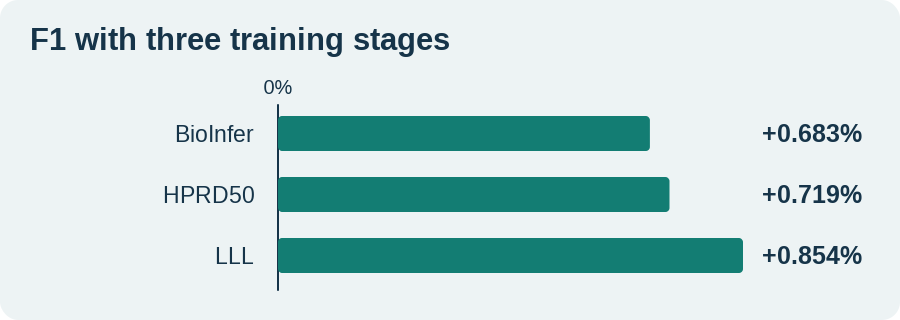
The team compared training stages across three text datasets
The researchers evaluated the approach on BioInfer, HPRD50 and LLL, which annotate mentions of interactions in published text. In the three-stage condition, the team trained on other datasets before adapting the model to the target dataset. The F1 score, which combines precision and recall, rose from 0.645 to 0.683 on BioInfer, from 0.707 to 0.719 on HPRD50, and from 0.786 to 0.854 on LLL. One two-stage condition on LLL scored 0.860, higher than the three-stage result of 0.854.
Negation and simple co-occurrence led to mistakes
The authors found cases where the model misread negation or contrast, took two proteins appearing in the same sentence to mean that an interaction was described, or misinterpreted language about regulation. The study measured how well the model’s classifications matched existing annotations in published text.