Existing AI translates and synthesizes Taiwanese Hokkien, with mixed script earning 3.76 for pronunciation
Yu-Kai Guo and colleagues reported in the November proceedings of ROCLING 2026 on a method for generating Taiwanese Hokkien text and speech with existing language and speech synthesis models. In an evaluation by 10 Taiwanese Hokkien speakers, pronunciation accuracy scored 3.763 out of 5 when the input combined Chinese characters with Tâi-lô, the romanization for Taiwanese Hokkien. Input using Chinese characters alone scored 2.820.
A specialist assessed Mandarin-to-Taiwanese Hokkien translations
The team tested translation in both directions between Standard Mandarin and Taiwanese Hokkien. One evaluator familiar with written Taiwanese Hokkien assessed Mandarin-to-Taiwanese Hokkien translations based on 20 source texts. Gemini 3.1 Pro Preview scored 4.80 out of 5 for accuracy of meaning in both Chinese characters and Tâi-lô. It scored 4.80 for idiomatic Taiwanese Hokkien in Chinese characters and 4.45 in Tâi-lô. Smaller models fine-tuned for Taiwanese Hokkien also performed on par with some larger cloud models.
Listeners rated 30 sentences, and automated selection results are preliminary
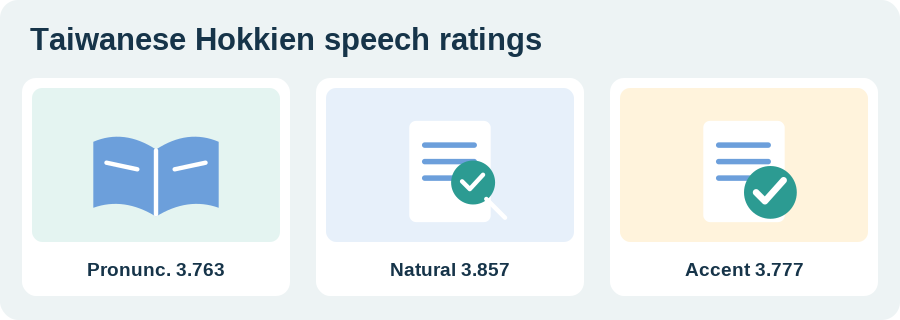
The researchers synthesized 30 sentences with Gemini 3.1 Flash TTS, and 10 native speakers rated them. Combining Chinese characters and Tâi-lô yielded scores of 3.763 for pronunciation accuracy, 3.857 for technical naturalness, and 3.777 for Taiwanese Hokkien accent, each out of 5. All three scores were lower with Chinese characters alone. The 13 clips selected by AI received an average human rating of 4.005, compared with 3.799 across all 30 clips. Selection and evaluation used the same 30 clips. Agreement between AI and human ratings for individual clips was weak.