At the same audio bitrate, bit allocation methods ranked differently across metrics

Li-Hong Guo reported how changing the bit allocation for different sound components affected the reconstruction of compressed environmental audio. In the November ROCLING 2026 proceedings, the study found that with the same amount of data transmitted, metrics for waveform error and predicted audio quality favored different methods.
Tests on 500 clips found the masking weights could not explain the gain
The study selected 500 clips from the ESC-50 environmental sound dataset and tested a prototype using a modified discrete cosine transform (MDCT) to split sound into frequency components. At about 191.73 kilobits per second, an allocation method that accounts for how louder sounds can mask quieter ones scored higher on segmental signal-to-noise ratio (segSNR) than a method weighted by frequency-band width. Removing the masking-related weights raised segSNR further. The width-weighted comparison method performed better on the predicted audio-quality measure.
Preserving acoustic features showed no classification gain
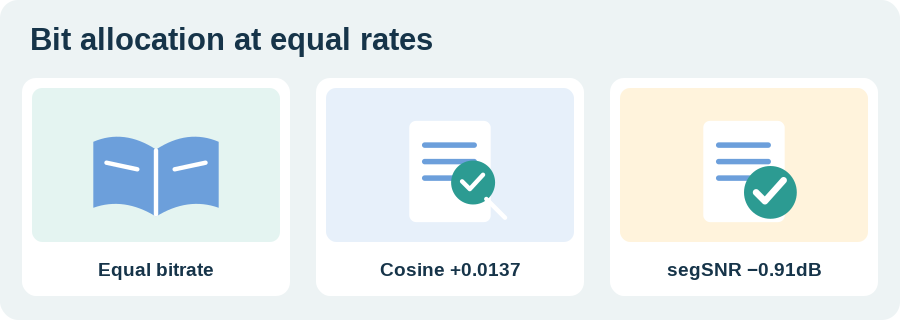
The allocation method aimed at retaining the original frequency characteristics was tuned on 50 environmental sound clips and evaluated on 100 separate clips. With the same number of transmitted bytes and the same search budget, log-mel cosine similarity rose by 0.0137 while segSNR fell by 0.91 decibels. A test of environmental sound classification did not demonstrate improved accuracy. The results are limited to the prototype and the environmental sound data. Listener evaluation was left for future work.