SynBERT scores 65.26 on a test of whether scientific English sentences need editing

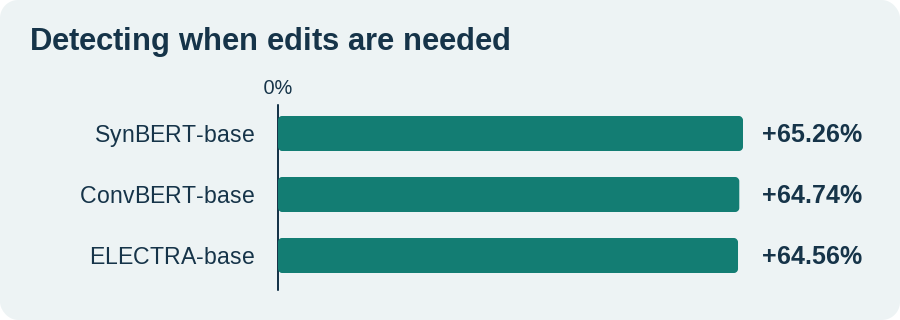
Zhe-Yu Xu and colleagues presented SynBERT, a model that classifies individual sentences in scientific papers according to whether their English needs editing. In the ROCLING 2026 proceedings, published in November, the researchers reported an F1 score of 65.26 on AESW 2016. That was higher than the scores of the pretrained models and shared-task systems listed in their comparison.
Training on scientific writing captures sentence meaning and nearby word relationships
The researchers pretrained the model on about 2.34 million scientific papers selected from S2ORC. The model combines three mechanisms to capture information such as the meaning of a whole sentence and relationships among nearby words. For evaluation, the researchers used AESW 2016, which contains annotations by English-language editors marking whether sentences from 9,919 papers across nine fields, mostly mathematics and physics, needed editing.
The model still makes mistakes on subtle changes
Of the sentences the model flagged as needing edits, 64.62% were correctly flagged. It found 65.91% of the sentences annotated as needing edits. The F1 score, which combines these two measures, was 65.26, compared with 64.74 for ConvBERT-base and 64.56 for ELECTRA-base. The study noted errors on subtle edits such as punctuation and word order. It evaluated whether sentences needed editing. Generating suggested edits was left for future work.