Native speakers annotated 1,243 uses of Sundanese particles

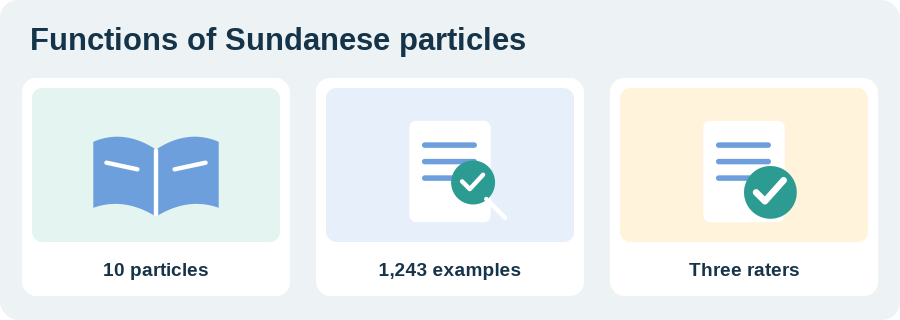
Irwan Setiawan and colleagues classified Sundanese particles by their conversational functions, such as marking a topic or emphasizing a statement. In the November proceedings of ROCLING 2026, the researchers report that they collected 1,243 examples of 10 particles from three sources of scripted and literary dialogue. Three native-speaker specialists independently classified each use.
Agreement rose when two categories were merged
The raters applied the same set of 12 functions to all particles. They later discussed disagreements to establish reference labels. Agreement on the main function was 0.828 on Fleiss’ kappa, which accounts for chance agreement. It rose to 0.938 when the researchers merged topic management and focus emphasis. For the particle téh, kappa was 0.251 with the finer categories, and the raters agreed on every example after the merger.
The value of context depended on how the data were split
On a fixed test set, a baseline that chose each particle’s most common function scored 0.670 on macro F1. XLM-R, using the particle and its context, scored 0.669. In five folds that kept each conversation group together, a word-frequency method averaged 0.722, versus 0.670 for the baseline. The authors reported smaller gains for particles with multiple functions and low scores for classification from context alone.