Grouping chat messages by author matched or beat trained models on an IRC test

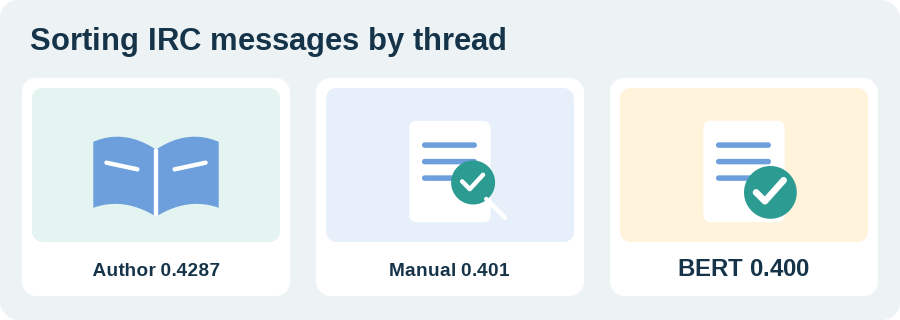
In the November proceedings of ROCLING 2026, Ishan Katoch re-evaluated methods for sorting interleaved messages into separate conversations. On a public IRC benchmark, grouping messages by author within each file scored 0.4287 on the adjusted Rand index (ARI), which measures agreement with human-labeled threads. The simple grouping matched or exceeded the trained models tested.
About 63% of reference threads contained one message
The test data contained 5,000 IRC messages. Of the human-labeled threads, 63.1% contained one message and 69.3% involved one speaker. Katoch said this structure favored grouping by author. The trained models were evaluated by clustering the entire test set at once or clustering each file separately. Both protocols were given the true number of threads, information a real system might not have.
Handcrafted features and BERT scored similarly in the per-file comparison
Using the same graph model, per-file clustering with annotated reply links yielded mean ARI scores of 0.401 for handcrafted features such as message position and length and 0.400 for representations from BERT-large. The difference was not statistically significant across five runs. Clustering the full test set with annotated reply links yielded 0.377 and 0.392 respectively. The author did not test that difference for significance. An earlier version favoring handcrafted features was corrected after the author found that the inputs had been scaled differently.