Taiwan Tech team reports unranked scores for emotion analysis of migrants’ Chinese-language writing
Yu-Cheng Chao and colleagues at the National Taiwan University of Science and Technology reported in the November proceedings of ROCLING 2026 on a method for estimating emotional valence and arousal from Chinese-language texts about migrants’ experiences. Across 1,100 test texts, the mean absolute error for arousal was 0.8159. Organizers published the Taiwan Tech team’s scores for reference and left the team out of the official ranking.
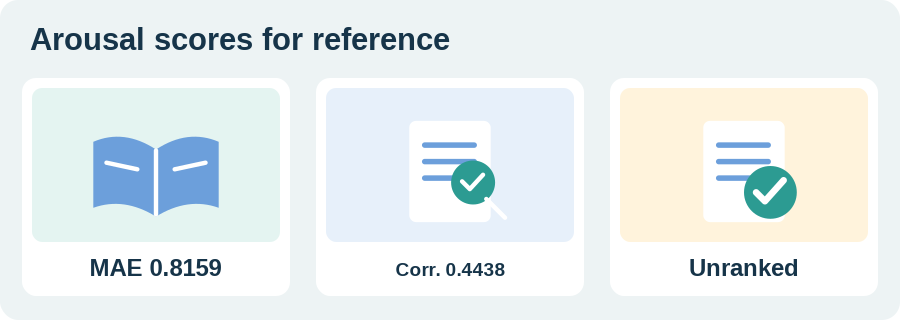
The task measured valence and arousal using error and correlation
The task estimated whether emotions were positive or negative (valence) and how intensely they were felt (arousal). The team combined predictions from pretrained Chinese-language models, large language models, and lexicons of emotion words, among other sources. Mean absolute error and Pearson correlation were 0.5555 and 0.8951 for valence and 0.8159 and 0.4438 for arousal. On the same test data, CYUT, the officially first-ranked team, had an arousal mean absolute error of 0.8658 and outperformed Taiwan Tech on both valence metrics. Organizers left Taiwan Tech unranked because the team did not complete the submission process by the deadline.
Tuning on test feedback could make gains look larger
The Taiwan Tech team adjusted how it combined predictions using scores returned during the test. In a replay using 2025 data under conditions similar to those in 2026, the researchers estimated that the gains for arousal could appear larger by about 0.016 for correlation and 0.008 for mean absolute error. The estimates came from that replay, which differed from the 2026 test in its data and some of its models.