Two language models represented Taiwan differently in English and Taiwanese Mandarin
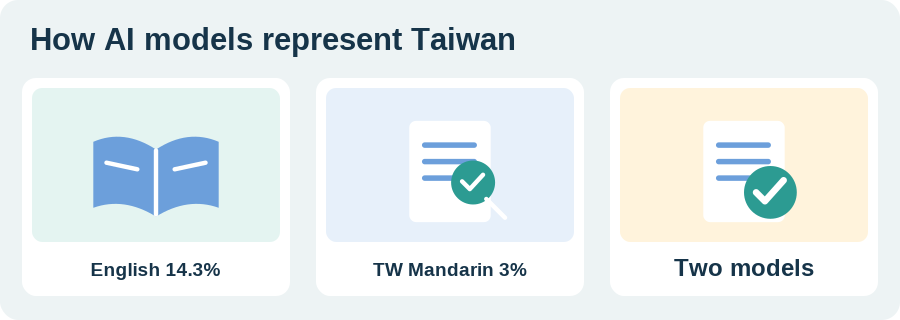
Guan-Yu Tseng and colleagues at National Taiwan University reported that large language models represented Taiwan differently internally even when English and Taiwanese Mandarin sentences had the same meaning. In the study, published in the November ROCLING 2026 proceedings, the researchers converted internal representations into text and classified them. China-centered geopolitical descriptions accounted for 14.3% in English and 3.0% in Taiwanese Mandarin.
Comparing equivalent sentences in two languages
The researchers gave Qwen2.5-7B and Gemma-3-12B sentences matched in meaning across English and Taiwanese Mandarin. They converted the internal representations for Taiwan into readable text and classified the context in which it was described. Japan and Iceland served as controls and did not show the same pattern as Taiwan.
The percentages come from an analysis of internal representations
The team measured the share of descriptions that fell into a China-centered category after translating the internal representations into text with its research method. In terms of how far the internal representation moved when the language changed, Taiwan did not move farther than Japan or Iceland. The authors said the study could not establish whether similar differences would appear in answers the models give users.