OpenAI releases GPT-6.2 Astra and Sol for complex and everyday work

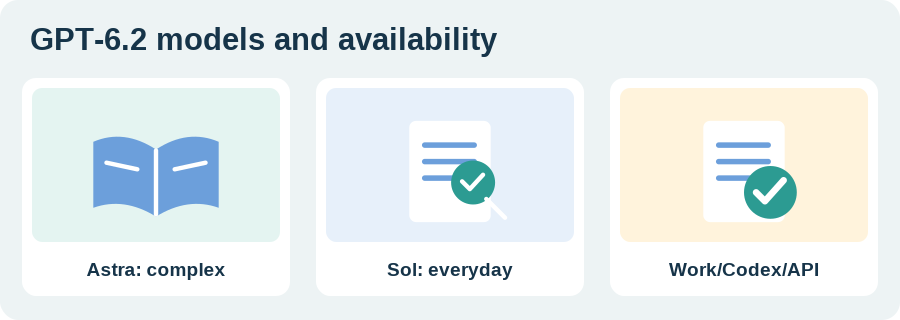
On November 17, US company OpenAI released GPT-6.2 Astra for complex professional work and GPT-6.2 Sol for everyday tasks. Users on eligible plans can try both in ChatGPT Work and Codex desktop. Standard API prices for Astra input and output are 20% lower than for its predecessor.
Astra follows document templates more closely
OpenAI says Astra follows user-provided templates and industry conventions more closely when creating slides, spreadsheets, and documents. On the company’s internal GDPval v2 evaluation, which uses professional tasks with multiple stages, Astra scored 6.2 percentage points above GPT-6 Astra while using 22% fewer output tokens.
Sol is designed for everyday tasks and multistep work
Sol is designed for everyday writing and work that involves multiple steps. OpenAI says it scored 5.3 points above GPT-6.1 Sol on GDPval v2. On Cognition’s FrontierCode 2.0, which evaluates changes to existing codebases, OpenAI reports that Sol came within 0.5 points of Astra at about one-fifth the cost, with both models at their maximum settings.
Eligible plans and API pricing
Both models are in preview in ChatGPT Work and Codex desktop for Plus and Pro users and eligible Enterprise and Edu workspaces. Enterprise and Edu workspace administrators must enable the preview. Standard inference is supported in the US and EU, and workspaces that require inference in the United Arab Emirates are ineligible. The faster Ultrafast setting is available for both models on Pro 500 and initially for Sol on Pro 200. Eligible Enterprise and Edu users need their administrator to enable access to Ultrafast. Developers can use both models through the API. Standard Astra rates per million tokens are $8 for input, $0.40 for cached input, and $40 for output. Sol keeps the previous generation’s rates of $2 for input, $0.10 for cached input, and $10 for output.