ITMO benchmark cuts AI research time to about one-sixth with a diffusion model
Russia’s ITMO University reported results on November 17 for DiffResearch, an AI system that gathers information from multiple sources and writes reports. Replacing the autoregressive model with a diffusion model in the same system reduced the average time across 100 tasks from about 71 seconds to about 12.
A comparison with the same retrieval and evaluation setup
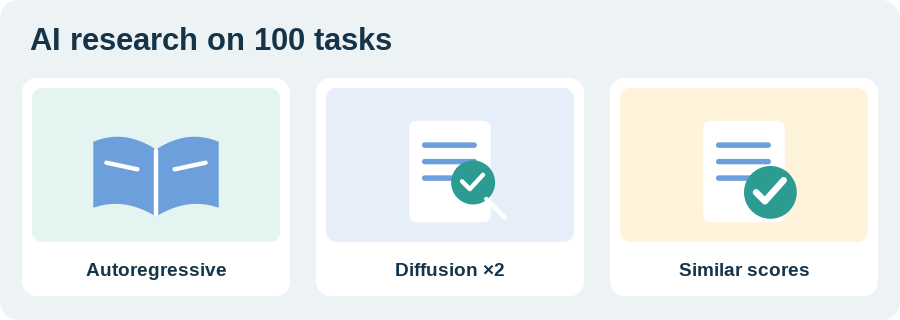
The researchers compared two language models of similar size while keeping the research workflow, retrieval code, prompts and evaluation method the same. They used Deep Research Bench, which includes 100 tasks across 22 fields. Average times for the two diffusion model settings were 11.89 and 11.97 seconds, compared with 71.45 seconds for the autoregressive model. Planning and writing accounted for most of the savings.
Similar overall scores in automated evaluation
RACE, an automated evaluation of report coverage, insight, adherence to instructions and readability, gave the autoregressive model an overall score of 0.3904 out of 1. The two diffusion settings scored 0.3895 and 0.3969. The experiment used specific models and hardware. The paper appeared in the industry track proceedings of the EMNLP 2026 natural language processing conference.