Google tests quantum contextuality and uses up to 105 qubits in a separate task

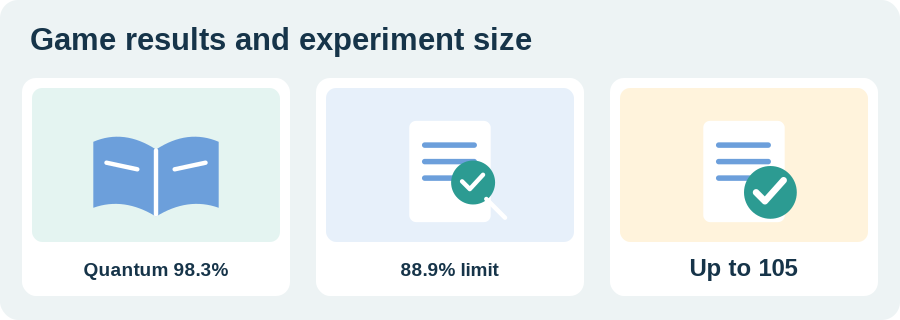
On November 19, Google said experiments with a quantum processor demonstrated behavior associated with measurement contextuality. The quantum win rate in a magic square game was 98.3%, exceeding the classical limit of 88.9% under the same rules. A separate task used up to 105 qubits. The research was published in Science.
The magic square game exceeds the classical limit
Measurement contextuality is a property of quantum mechanics in which a measurement outcome cannot be explained independently of which compatible measurements are made alongside it. Google Quantum AI used four qubits on its Willow processor for a magic square game in which two players answer without communicating. The best classical strategy can win 88.9% of rounds under these rules. The team reported a quantum win rate of 98.3%.
A separate task uses up to 105 qubits
In a separate experiment, the team used a lattice of up to 105 qubits to test a task that involved finding a hidden linear function. Google said the success rate exceeded the predicted limit for classical strategies with restricted circuit depth. It said the tasks could also help detect small errors in quantum computers.