Gemini API preview fetches tool definitions only when needed

On November 19, Google introduced a preview of Tool Retrieval in the Gemini Interactions API. It loads tool parameter definitions on demand to help reduce input token use in workflows that use many tools. The preview supports Gemini 3.6 and later, including all Gemini 4 models.
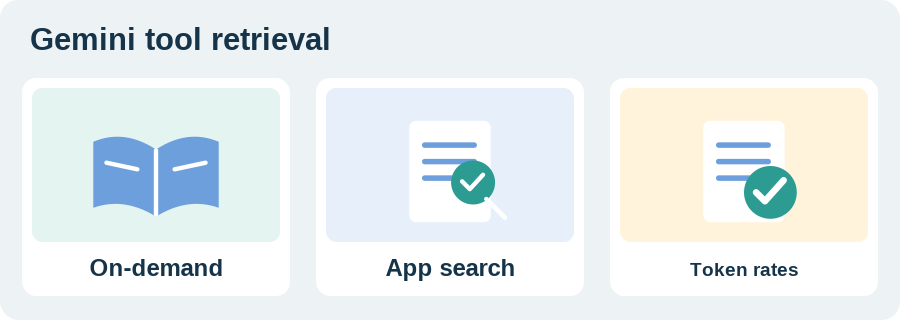
Tool names and descriptions come first
With Google-hosted tool search, the model sees the names and descriptions of available tools and selects those it needs. The API then loads the parameter definitions, which specify details such as argument names and types. This works with functions registered by developers and with tools on remote servers connected via the Model Context Protocol (MCP).
Applications can search their own tool lists
Developers who maintain their own tool lists can search from their application and return the matching definitions to the API. Application-side search adds one network round trip per search.
Loaded definitions are billed at standard token rates
Google says there is no separate fee for the feature. The model’s usual input and output token rates apply. Enabling Tool Retrieval adds a set number of input tokens. Loaded definitions are also billed as input in the subsequent conversation. The savings depend on how many tools are registered and which definitions are loaded.