Seoul National University’s phosphor absorbs about 80% of blue light

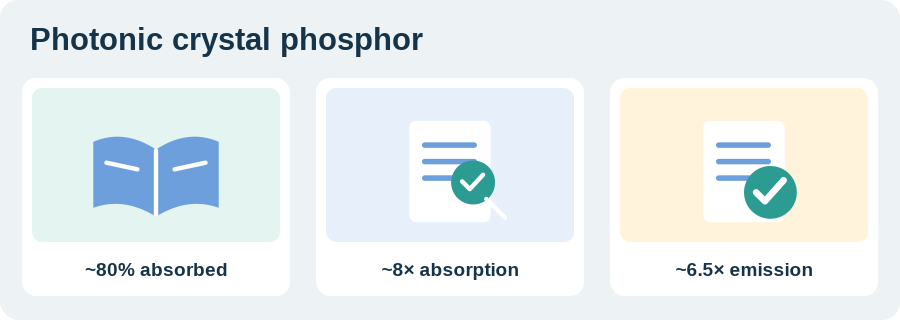
Seoul National University’s Department of Physics and Astronomy announced on Nov. 20 that researchers had made a photonic crystal phosphor that absorbs about 80% of blue excitation light. Compared with a flat sample containing a comparable amount of quantum dots, it had about eight times the absorptance and 6.5 times the fluorescence. Advanced Science published the paper online on Nov. 18.
Nanopillars leave more room for quantum dots
The researchers replaced nanoscale holes in a titanium dioxide photonic crystal with an array of nanoscale pillars. The geometric fraction of the patterned layer that could be occupied by colloidal quantum dots increased from about 28% to 72%.
The design aligns two resonances
The researchers adjusted the crystal’s thickness and the pillars’ size so that two resonances overlap in the blue excitation wavelength range. The university says the design could help develop displays and lighting that require effective color conversion and high color purity.