OpenAI’s chief scientist proposes a common measure of AI pretraining progress
In an essay published on 22 November, OpenAI Chief Scientist Jakub Pachocki proposed using perplexity to compare progress in AI pretraining across developers and inform shared safety standards. He also published measurements for several OpenAI models on an evaluation dataset drawn from the company’s internal code.
Measuring how well a model predicts the next token
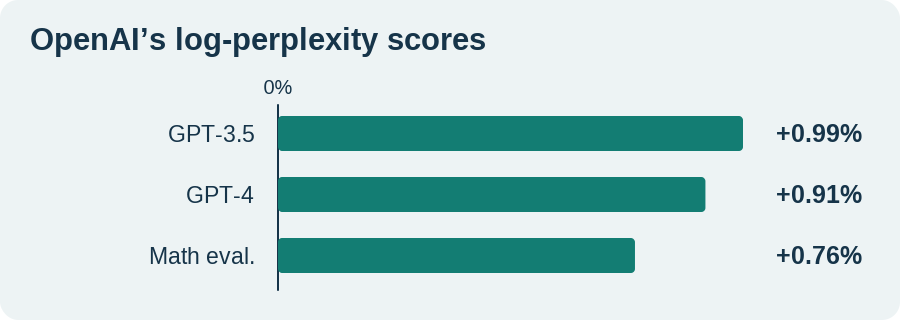
Perplexity measures how well a model predicts the next token on average, where tokens are the units a model splits text and other data into. Lower values indicate better predictions. The essay reports the logarithm of perplexity, known as cross-entropy loss. OpenAI used an evaluation dataset kept separate from training and drawn from a fixed snapshot of its internal codebase. GPT‑3.5 scored about 0.99, GPT‑4 about 0.91, and a model used to evaluate open mathematics problems about 0.76.
A proposal for shared limits and monitoring milestones
Pachocki proposed that AI developers agree on standards for model evaluation and transparency, and commit to staying within development limits measured by perplexity and other metrics until tools for understanding and monitoring model behaviour reach a defined milestone. He said differences in training and evaluation data make comparisons between developers difficult. Perplexity measures prediction quality. Assessing performance on particular tasks or improvements outside pretraining requires other measures, he said. The theoretical lower bound of perplexity is unknown.