Amazon reports a 104-millisecond wait for a robot’s next action on Trainium3

On November 23, US company Amazon described an example of physical AI, which perceives real environments, makes decisions and acts. Runway worked with Amazon’s chip development team to tune its model for Trainium3, an AI chip from Amazon Web Services (AWS). Amazon said the robot waited 104 milliseconds before starting its next action, below Runway’s 150-millisecond benchmark for real-time operation.
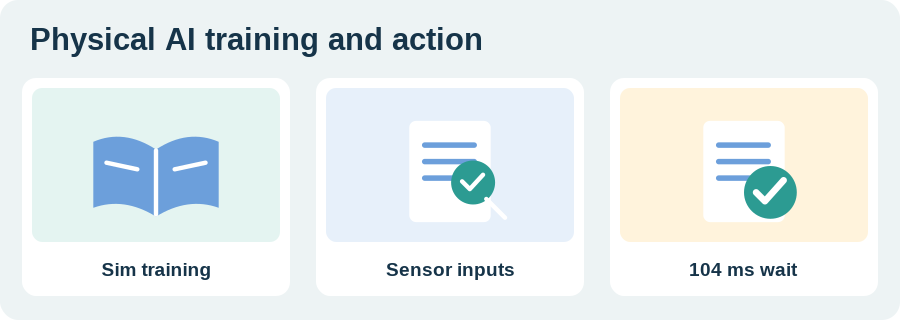
Training and real-world operation use computing in different ways
Amazon explained that robots need fast inference to process new inputs from cameras and sensors as they operate. For training, it described reinforcement learning, in which performance improves through trials, and gave the example of training many virtual robots in parallel in a simulation.
Runway tuned a model that learns from video
Runway worked with Amazon’s chip development team, Annapurna Labs, to tune the Praxis-1 video-trained model and its computation to run on Trainium. When using Trainium3, Amazon measured a wait of 104 milliseconds before the robot’s next action. Runway’s target was 150 milliseconds.