AWS CEO calls for limiting AI agents’ permissions and monitoring them independently
On November 23, Amazon published an opinion piece on AI safety engineering by Matt Garman, CEO of Amazon Web Services (AWS). He proposed giving AI agents their own identities, limiting their permissions to what they need, and combining isolated execution environments with monitoring that operates independently of the model.
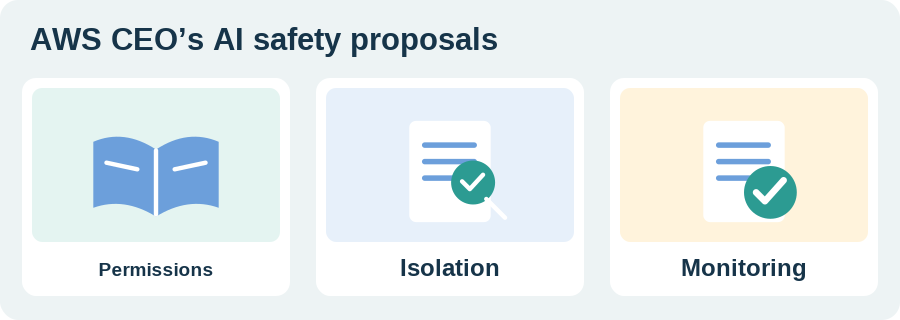
Give each agent an identity and log its actions
Garman argued that an AI agent’s permissions should be capped at those of its user, with narrower permissions in many cases. He called for enforcing access controls at the infrastructure level and logging each action so it can be traced.
Isolate workloads and monitor them at the infrastructure level
Garman cited AWS’s Firecracker, a lightweight virtual machine technology that isolates workloads at the hardware level. He said AWS uses dedicated hardware called Nitro to separate security functions from general-purpose computing. He argued that the infrastructure should generate monitoring data independently so operators can see what agents are doing.
Formally verify access boundaries where applicable
Garman said automated reasoning, which uses mathematical methods to prove properties of a system, can formally verify what a model can access in some applications. The opinion piece advocates defense in depth through layers of access control, isolation, monitoring and verification.