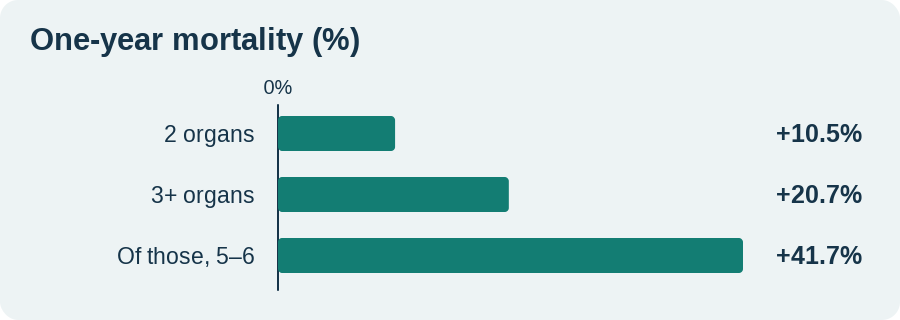
One-year mortality after liver transplantation varied by the number of organs failing
On November 25, the University of São Paulo reported on an international study following 995 adults with decompensated cirrhosis. Among transplant recipients, one-year mortality was 20.7% for patients with at least three organ failures at transplant and 41.7% for the subgroup with five or six.
Study followed adults with decompensated cirrhosis at 63 centers
The prospective observational study, called CHANCE, followed 995 adults with decompensated cirrhosis for one year across 63 liver transplant centers in Europe, Asia and the Americas. Researchers at the University of São Paulo Medical School and patients treated at its Hospital das Clínicas took part. The study examined outcomes by the presence and severity of acute-on-chronic liver failure (ACLF). Of the patients followed, 612 underwent liver transplantation.
Mortality among recipients varied by severity
The study treated retransplantation and death as separate outcomes. In its analysis by severity of multiple organ failure, one-year mortality after transplantation was 10.5% in the ACLF-2 group, whose patients had two organ failures at transplant. It was 20.7% across the ACLF-3 group, with at least three organ failures, and 41.7% in the subgroup with five or six. Among the 144 patients who were not selected for transplant, 73% with ACLF-2 and 88% with ACLF-3 died within a year of enrollment. Transplants were not randomly assigned. The groups differed in their clinical condition and selection criteria.